Pages

New Zealand - Aotearoa by BlossomFlowerGirl

New Zealand Time

Aotearoa Snapshots

Click on Flag or Select Your Language to Translate

ArabicChinese (Simplified)DutchEnglishFrenchGermanHindiIndonesianItalianJapanesePortugueseRussianSpanishTurkishUrduBengaliNepali

Tēnā koutou katoa

This is all about New Zealand - Aotearoa - and the time I spent there. Magical times, beautiful scenery, gushing geysers, thermal wonderlands. Hear about Waitangi Day, discover the meaning of the word "Aotearoa", see the Glaciers, read about hangis and Hakas, and visit the beautiful Bay of Islands. So come with me on a journey - a journey to The Land of The Long White Cloud.
Kia ora


CHRISTCHURCH EARTHQUAKE TRIBUTE 2011


Watch The Haka

Showing posts with label I. Rotorua. Show all posts

30. Rotorua - Wai-O-Tapu

Tuesday 9 January


Wai-O-Tapu Geothermal Area is the most diverse and spectacular geothermal area in the Taupo Volcanic Zone. The publically accessible part is only a small portion of the 18 square km area.


Champagne Pool

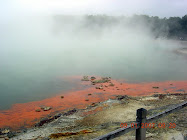
Colouful mineral deposits in overflow from Champagne Pool Hot Spring


Devil's Ink Pots

Devil's Ink Pots (crude oil and graphite form dark areas on surface.


Thunder Crater

Thunder crater - collapse feature formed in 1968.

Keep Off The Grass!

We were told not to try dipping our hand in any of the pools or go walking off the designated tracks - otherwise we'd "fry."


Primrose Sinter Terrace

After destruction of the Pink and White terraces in lake Rotomahana by the 1886 eruption of Mt. Tarawera, touristic focus in the area shifted to Wai-O-Tapu which had the largest remaining sinter terrace in New Zealand.

Wai-O-Tapu is located on the northern perimeter of the Reporoa caldera. This caldera is approximately 10x15 km in size and was formed 230000 years ago during a massive eruption which emplaced 100 cubic kilometers of breccia (ash and pumice) referred to as the Kaingaroa Ignimbrites. These are over 30m thick in places. Around the time of the Kaharoa eruption of nearby Tarawera (800 years ago) a number of large hydrothermal eruptions occurred in Wai-O-Tapu. Drill holes at Wai-O-Tapu show that the current source of heat is located under the N margin of Reporoa and the S part of Wai-O-Tapu.

Rainbow Crater

Colours are the result of sulphur and other minerals exposed.


Obey The Signs

29. Rotorua - Wai-O-Tapu

Tuesday 9 January


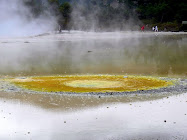
Artist's Palette

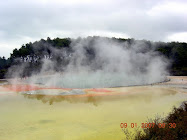
Sulphur rich hot spring. Overflowing water from the Champagne Pool draws with it minerals that have originated from below the surface. As the waters cool and the minerals are exposed to the atmosphere, they show in a variety of colours depending on wind direction and water level.


Thou Shalt Not Throw Stones!

The sign speaks for itself.


Opal Pool

Such a beautiful colour, but oh, so deadly.


Sinter (Silica)Terrace Crossing


Champagne Pool

The surface features of the geothermal area are generated by groundwater that is superheated deep underground by old magma bodies which have not yet fully cooled. The superheated water dissolves minerals from rocks and deposits underground and deposits these in places where it reaches the surface and evaporates.

The colours of the deposits indicates the minerals involved in the process - green (colloidal sulphur / ferrous salts), orange (antimony), purple (manganese oxide), white (solica), yellow (sulphur), red (iron oxides) and black (sulphur / carbon).

28. Rotorua - Wai-O-Tapu

Tuesday 9 January


Rainbow Crater

Well over a dozen craters are located within close proximity. They range from 5-50 metres in diameter and up to 20 metres deep. All were formed by the ground surface collapsing. It is believed under this area subterranean waterways have eroded away rock structure alowing the surface ground to collapse away forming craters. Many craters have various types of geothermal activity such as boiling pools, steam fumeroles, sulphur vents and mud pools. The pumice ground is this area is coloured by various oxides.

Purple - Magnanese Oxide,
Red/Brown - Ferrous Oxide
Yellow - Sulphur.


Inferno Crater

The crater has a bottom of violently boiling mud. In recent history an earth archway linking the sides has been completely destroyed by the action of acidic steam.


Champagne Pool

The pool fills a 900 year old crater which is roughly 60 metres across and 60 metres deep. The waters are tinted green with arsenic, sulphur and iron compounds. It bubbles with carbon dioxide at about 74º C and deposits orange antimony and traces of gold, silver and mercury on its rim and the huge sinter terraces that drain it.


Champagne Pool

Orange Antimony-rich deposits. The Champagne Pool is the most colourful and most popular.

Champagne Pool

Mineral deposits give the Champagne Pool at Wai-O-tapu Thermal Wonderland near Rotorua its edges the beautiful colours and unique formations

27. Rotorua - Geysers & Geothermal Wonders

Tuesday 9 January

Our driver, Paris was over 25 minutes late in arriving and told us he didn't have time because of this to take us past the Government Gardens. Many, in fact, most, of the passengers complained loudly about this, as this was one of our "highlights", and you could have cut the air with a knife - the temperature dropped about 10 degrees! He (the driver) tried very hard to joke and stuff, but the passengers were not forgiving.

Wai-O-Tapu was fantastic, but we didn't have nearly enough time there. The time spent at a bungy jumping place later in the day was very long and very boring. It would have been better having more time at the geothermal areas and less at the bungy jump. We had to drive past the hostels to get to the bungy thing and many passengers asked could they be dropped off there as they weren't interested in looking at the bungy jump place.

Nothing doing - we all had to hang around at the bungy jump place. The weather had steadily worsened after leaving Wai-O-Tapu, and it was absolutely pouring, and when we did finally get to our hostels, you couldn't go anywhere - it just continued to pour buckets.


Geothermal Activity

As we approached the geothermal areas you could see the activity going on from the bus.


Lady Knox Geyser

Our first stop was at the Lady Knox Geyser which erupts every day at 10.15am - soap is dropped into the opening vent to ensure this occurs. Depending on the weather, the eruption can be up to 20m and rocks are placed around the base to enhance this.

Lady Knox Geyser


In 1901 the first open prison in New Zealand was established at Wai-O-Tapu to house some of the better behaved prisoners from around the gaols of the Rotorua Lakes District.

Some of those prisoners discovered the clearing in which the geyser is situated and that the spring could be made to erupt by adding soap - as they found when they first used the hot water to wash their clothes.

Our next stop was at Wai-O-Tapu which in English means "Sacred Waters."


Wai-O-Tapu

Above is the entrance which leads to a gift shop with many souvenirs for sale.


Entrance Garden


After going through the gift shop, you walk along this walkway which leads you to the geothermal "park."

Map of Wai-O-Tapu


Steaming Fumeroles - The Devil's Home


The Devil's Bath Lake


The green color is from colloidal sulphur/ferrous salts.

The luminous green Devil's Bath is a large rugged edged crater near the bush line with amazing natural water colour at its base. The colour comes from the excess water from the champagne pool mixing with sulphur and ferrous salts. Changes in colour through Green to Yellow are associated with the amount of reflecter light and cloud cover.

26. Rotorua Snapshots

Monday 8 January

After a very late night today was a bit of a lazy day with a late rise out of bed and amble around just enjoying what was around.

Rotorua Collage


At the end of the day, an easy tea was the order of the day - 3 eggs, tomatoes and 4 pieces of toast at 9.30pm. Then pack the case ready for tomorrow's early start.

25. Rotorua - Tamaki Māori Village 4

Sunday 7 January

After the concert we were taken into the dining hall for a traditional hangi. Hangi is the traditional Māori way of cooking food. A huge pit is dug, the food is placed in baskets in particular layers and the pit sealed. It is then left to cook for several hours.

As there were many tables, each table was called up in turn. The table I was at was one of the last to be called up, so we missed out on a couple of things. I had kumera, potato, roast lamb and chicken. Dessert was pavlova and steamed pudding. I had both - yes, yes, I know it was greedy, but what the heck, you only live once and who cares about calories when they're on holiday anyway?

I bought a glass of "Tamaki Punch" which was $6.50. At the gift shop, I later purchased a fridge magnet in the shape of a kiwi for $7.80.

Cooking Pit

One of the several cooking pits. In the background you can just make out part of the dining hall.


Totem Pole

Each totem pole tells a story about the person or tribe who carved it.


Wharepaku


Suddenly it was after 10 o'clcok and it was time to head back. We all piled into the bus filled with bonhomie and food and at our driver's instigation started singing a song or two.

As we approached the roundabout to turn into Rotorua, our driver said, "Come on everybody, let's all sing The Wheels of the Bus" So we sang along with him - "The wheels of the bus go round and round, round and round, round and round, The wheels of the bus go round and round..." and as we turned the roundabout, to our amazement, he didn't go to Rotorua, but kept going around and around and around in circles. You should have seen the looks of surprise at the drivers (and passengers) of the cars stopped there as not one, but five or six buses went around and around and around one after another.

Mark told us they did this every night - the locals are used to it and sometimes come out to watch, but the tourists don't know what hit them! We were all in stitches, almost rolling around on the floor with laughter.

This was the highlight of my New Zealand trip, as I knew it would be and I would recommend to anyone going to NZ to do this tour - it's fantasy, history, and fun all rolled into one.

Kia Ora.

24. Rotorua - Tamaki Māori Village 3 - The Haka

Sunday 7 January

The famous Haka
And finally, came the pièce de résistance - the Haka! This was what I wanted to see more than anything and it was the highlight of the evening.


The Haka

Sitting just a few feet away from these huge blokes all decked out with tattoos and traditional Māori dress, waving their arms, ferocious scowls on their faces, chanting and yelling loudly in the middle of a forest, pitch black is quite an experience, let me tell you. I mean, I knew it was a concert, and I knew we were all safe and happy, but...I wouldn't like to have been their enemy in olden times.

Watch the Haka


The Battle Haka
The peruperu is characterised by leaps during which the legs are pressed under the body. In former times, the peruperu was performed before a battle in order to invoke the god of war and to discourage and frighten the enemy. It involved fierce facial expressions and grimaces, poking out of the tongue, eye bulging, grunts and cries, and the waving of weapons. If the haka was not performed in total unison, this was regarded as a bad omen for the battle. Often, warriors went naked into battle, apart from a plaited flax belt around the waist. The aim of the warriors was to kill all the members of the enemy war party, so that no survivors would remain to undertake revenge.


The Origin of Ka Mate
The most well know Haka is the Ka Mate. In the early 1800's, a chief by the name of Te Rauparaha composed Ka Mate, the most well known of all haka. He was chief of the Ngati Toarangatira (Ngati-Toa) a branch of the Tainui tribe, and dwelt in Kawhia, north of the Waikato. There were inter-tribal wars - a bitter story of constant skirmish, reprisal and territorial dispute.

Ka mate, ka mate
Ka ora, ka ora
Tenei te tangata puhuruhuru
Nana i tiki mai whakawhiti te ra
Upane, upane
Upane kaupane
Whiti te ra.

These words are translated as:

It is death, it is death
It is life, it is life
This is the hairy man
Who caused the sun to shine again for me
Up the ladder, up the ladder
Up to the top
The sun shines.

This is the Haka as performed by the All Blacks.

A word on pronunciation

The 'wh' is pronounced as an 'f' or 'ph'.
The 'e' on the end of a word is sounded as if the word ended in 'ay' as in 'hay'.
The 'au' is pronounced as the 'ou' in 'hour'.
The 'u's are all long like 'ou' in 'you'.
The 'a's are all sounded long as in 'ah'

Kia Ora!

23. Rotorua - Tamaki Māori Village 2 - The Concert

Sunday 7 January

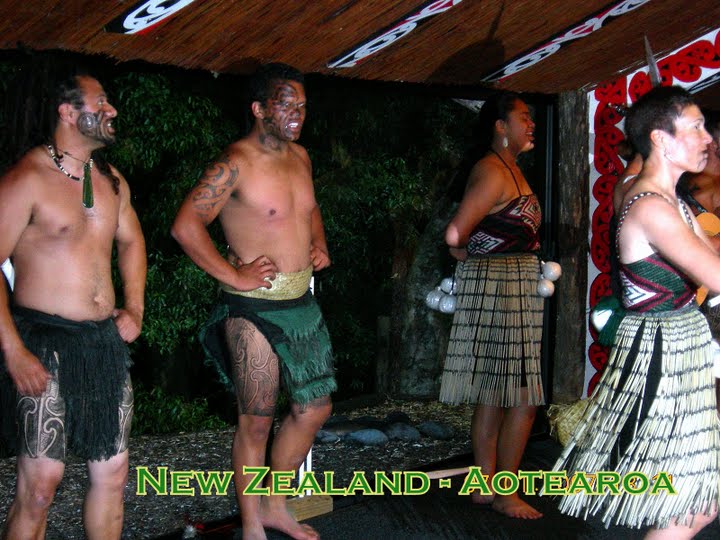
We we then tatken into a large room and watched traditional Māori dances.


Māori Dance

I was fascinated by the tattoos.


Māori Dance


Māori Dance

22. Rotorua - Tamaki Māori Village 1

Sunday 7 January

The mini-van picked me up from the hostel and then we stopped at the Tourist Office in Hinemaru Street, where we waited while a few other people boarded. Our driver was a jovial Māori chap called Mark and each time he opened or shut the door it made a shuddering clang! He was funny and fun to be with and welcomed us in different languages - I think he said he could say welcome in 74 languages!

He asked us what country we came from and told us we all had to do an imitation of a bird or animal native to our country. I did the Kookaburra. I'm pretty good at kookaburra impressions - if truth be told, it's the only one I can do.

Mark gave us a history about Māori - their customs, way of life etc. and told us we were a tribe and had to elect a Chief. Who'd like to be Chief he asked? Most put their hand up, including me. Then he dropped the bombshell - only a male could be Chief! He would have to go through the ritual of welcome when we reached the village, accept a challenge, pass a test, and make a gift to the village chief on our behalf - to show that we came in peace, not war. A nice-looking young bloke was made Chief (I remember he had blondish hair and was from California) and we all cheered and clapped.

Being Chief has its advantages - you get to eat first!


Village Entrance

After about a 20 minute ride, we arrived at the village and looked around with interest. Mark again reminded our "Chief" of the seriousness of the Pōwhiri (welcome ceremony) he was to participate in and we were instructed not to laugh, talk or move - it is considered extremely rude. We could however take photos.

Pōwhiri
The purpose of the Pōwhiri is to remove the tapu of the Manuhiri (visitors) to make them one with the Tangata Whenua (Home people). It is a gradual process of the Manuhiri and the Tangata Whenua coming together.

Māori Warrior

We entered the village forecourt and waited. A blood-curdling scream rang out from the forest

The Warrior Approaches


Guards

Then the warriors came - in traditional dress they looked fearsome and daring yelling out war cries.

Māori Warriors


Display of Weaponry


Karanga

The karanga usually indicates the start of the pōwhiri (formal welcome ceremony). Carried out exclusively by women and in the Māori language, karanga is initiated by the hosts (tangata whenua). The karanga generally begins with the initiating caller (kaikaranga) from the tangata whenua, and response caller (kaiwhakatu) from the manuhiri.
Like the whaikōrero (formal speech of welcome), karanga follow a format in keeping with correct protocol.

Marae


Marae


The Challenge

Amid war cries, the challenge is thrown down and our "Chief" is being given a test. Imagine having this fellow that close, aim his spear at you – a very effective way of frightening your enemies!


Māori Chief

Our "chief" passed the test, the Māori Chief and ours pressed noses, and we were welcomed into the village. (Sighs of relief)

Some may say it is all for show, for the tourists, and in a way it is - but what you should know, and remember is this..these customs are part of the Māori culture that stems back for hundreds of years, and has been handed down from father to son, from mother to daughter. In this way, their culture is not lost, but kept alive.

It was a most wonderful experience.
21. Rotorua - Accommodation

Sunday 7 January

Friends who had been to New Zealand all said, "You'll know when you arrive in Rotorua - you can smell it long before you get there - it smells like rotten eggs!"
Lovely.
As it turned out, yes, I did smell the pong for which Rotorua is noted, but it dissipated within a few minutes of arrival.

We arrived in Rotorua at 5.45pm - I was longing for a shower, change of clothes, and a cuppa! Alas, it was not to be - Cactus Jacks stuffed up my booking. They said I was not in the system, no bed available. Daniel, the security guard on duty found the notebook, my name written in pencil. I had been put in Room 17 or 7, - $65 a night.
Not happy Jan


Peter came back, said he would sort something out after I returned from the Hangi which I was going to. Returned 10.30pm - here's your key. Room 29. Filthy, disgusting mess. Turns out I was to share with two fellas. Gawd it stunk!

Not on mate. Got Pete, explained I had booked female dorm. Nothing available. Was given Room 7 - a double. Forty dollars for 2 nights.

Cactus Jacks

I couldn't get the whole place in one single photo, so I took two and joined them together, which is why it appears a little uneven. Cactus Jacks at 1210 Haupapa St Rotorua, has a Tex/Mex theme and this is reflected in the furnishings and outdoor courtyard.

Inside Snapshots

One of the other "inmates" at the kitchen sink. The lounge room. Kitchen table and chairs, and a close-up of the entrance.


The Courtyard

The courtyard out the back is in the middle with rooms going around. You can't see it, but there is a verandah (covered) with velvet lounge chairs and a sofa.
It wasn't all that clean - the cleanliness of the place left a lot to be desired, but the location was excellent and the atmosphere was fantastic - fun, happy, and had a real good feel to it.
Related Posts Plugin for WordPress, Blogger...