Sunday 7 January
After the concert we were taken into the dining hall for a traditional hangi. Hangi is the traditional Māori way of cooking food. A huge pit is dug, the food is placed in baskets in particular layers and the pit sealed. It is then left to cook for several hours.
As there were many tables, each table was called up in turn. The table I was at was one of the last to be called up, so we missed out on a couple of things. I had kumera, potato, roast lamb and chicken. Dessert was pavlova and steamed pudding. I had both - yes, yes, I know it was greedy, but what the heck, you only live once and who cares about calories when they're on holiday anyway?
I bought a glass of "Tamaki Punch" which was $6.50. At the gift shop, I later purchased a fridge magnet in the shape of a kiwi for $7.80.
Cooking Pit
One of the several cooking pits. In the background you can just make out part of the dining hall.
Totem Pole
Each totem pole tells a story about the person or tribe who carved it.
Wharepaku
Suddenly it was after 10 o'clcok and it was time to head back. We all piled into the bus filled with bonhomie and food and at our driver's instigation started singing a song or two.
As we approached the roundabout to turn into Rotorua, our driver said, "Come on everybody, let's all sing The Wheels of the Bus" So we sang along with him - "The wheels of the bus go round and round, round and round, round and round, The wheels of the bus go round and round..." and as we turned the roundabout, to our amazement, he didn't go to Rotorua, but kept going around and around and around in circles. You should have seen the looks of surprise at the drivers (and passengers) of the cars stopped there as not one, but five or six buses went around and around and around one after another.
Mark told us they did this every night - the locals are used to it and sometimes come out to watch, but the tourists don't know what hit them! We were all in stitches, almost rolling around on the floor with laughter.
This was the highlight of my New Zealand trip, as I knew it would be and I would recommend to anyone going to NZ to do this tour - it's fantasy, history, and fun all rolled into one.
Kia Ora.

Tēnā koutou katoa
This is all about New Zealand - Aotearoa - and the time I spent there. Magical times, beautiful scenery, gushing geysers, thermal wonderlands. Hear about Waitangi Day, discover the meaning of the word "Aotearoa", see the Glaciers, read about hangis and Hakas, and visit the beautiful Bay of Islands. So come with me on a journey - a journey to The Land of The Long White Cloud.
Kia ora
CHRISTCHURCH EARTHQUAKE TRIBUTE 2011
Kia ora
Watch The Haka
Showing posts with label z Hangi and Haka. Show all posts
24. Rotorua - Tamaki Māori Village 3 - The Haka
Sunday 7 January
The famous Haka
And finally, came the pièce de résistance - the Haka! This was what I wanted to see more than anything and it was the highlight of the evening.
The Haka
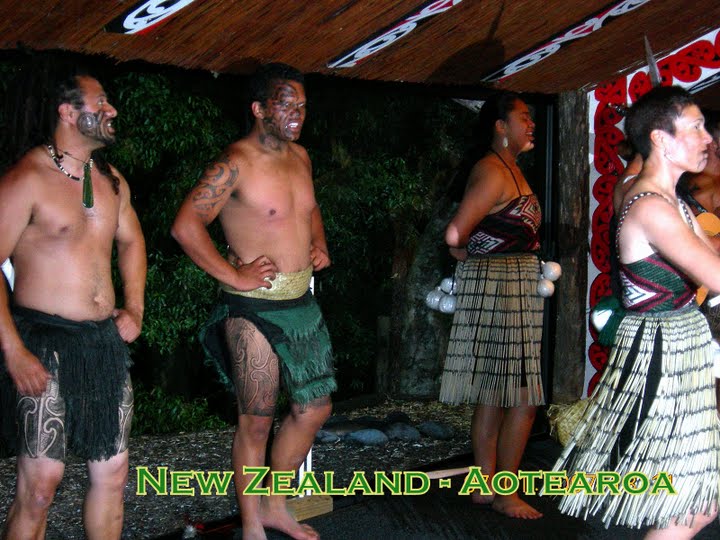
Sitting just a few feet away from these huge blokes all decked out with tattoos and traditional Māori dress, waving their arms, ferocious scowls on their faces, chanting and yelling loudly in the middle of a forest, pitch black is quite an experience, let me tell you. I mean, I knew it was a concert, and I knew we were all safe and happy, but...I wouldn't like to have been their enemy in olden times.
Watch the Haka
The Battle Haka
The peruperu is characterised by leaps during which the legs are pressed under the body. In former times, the peruperu was performed before a battle in order to invoke the god of war and to discourage and frighten the enemy. It involved fierce facial expressions and grimaces, poking out of the tongue, eye bulging, grunts and cries, and the waving of weapons. If the haka was not performed in total unison, this was regarded as a bad omen for the battle. Often, warriors went naked into battle, apart from a plaited flax belt around the waist. The aim of the warriors was to kill all the members of the enemy war party, so that no survivors would remain to undertake revenge.
The Origin of Ka Mate
The most well know Haka is the Ka Mate. In the early 1800's, a chief by the name of Te Rauparaha composed Ka Mate, the most well known of all haka. He was chief of the Ngati Toarangatira (Ngati-Toa) a branch of the Tainui tribe, and dwelt in Kawhia, north of the Waikato. There were inter-tribal wars - a bitter story of constant skirmish, reprisal and territorial dispute.
Ka mate, ka mate
Ka ora, ka ora
Tenei te tangata puhuruhuru
Nana i tiki mai whakawhiti te ra
Upane, upane
Upane kaupane
Whiti te ra.
These words are translated as:
It is death, it is death
It is life, it is life
This is the hairy man
Who caused the sun to shine again for me
Up the ladder, up the ladder
Up to the top
The sun shines.
This is the Haka as performed by the All Blacks.
A word on pronunciation
The 'wh' is pronounced as an 'f' or 'ph'.
The 'e' on the end of a word is sounded as if the word ended in 'ay' as in 'hay'.
The 'au' is pronounced as the 'ou' in 'hour'.
The 'u's are all long like 'ou' in 'you'.
The 'a's are all sounded long as in 'ah'
Kia Ora!
The famous Haka
And finally, came the pièce de résistance - the Haka! This was what I wanted to see more than anything and it was the highlight of the evening.
The Haka
Sitting just a few feet away from these huge blokes all decked out with tattoos and traditional Māori dress, waving their arms, ferocious scowls on their faces, chanting and yelling loudly in the middle of a forest, pitch black is quite an experience, let me tell you. I mean, I knew it was a concert, and I knew we were all safe and happy, but...I wouldn't like to have been their enemy in olden times.
Watch the Haka
The Battle Haka
The peruperu is characterised by leaps during which the legs are pressed under the body. In former times, the peruperu was performed before a battle in order to invoke the god of war and to discourage and frighten the enemy. It involved fierce facial expressions and grimaces, poking out of the tongue, eye bulging, grunts and cries, and the waving of weapons. If the haka was not performed in total unison, this was regarded as a bad omen for the battle. Often, warriors went naked into battle, apart from a plaited flax belt around the waist. The aim of the warriors was to kill all the members of the enemy war party, so that no survivors would remain to undertake revenge.
The Origin of Ka Mate
The most well know Haka is the Ka Mate. In the early 1800's, a chief by the name of Te Rauparaha composed Ka Mate, the most well known of all haka. He was chief of the Ngati Toarangatira (Ngati-Toa) a branch of the Tainui tribe, and dwelt in Kawhia, north of the Waikato. There were inter-tribal wars - a bitter story of constant skirmish, reprisal and territorial dispute.
Ka mate, ka mate
Ka ora, ka ora
Tenei te tangata puhuruhuru
Nana i tiki mai whakawhiti te ra
Upane, upane
Upane kaupane
Whiti te ra.
These words are translated as:
It is death, it is death
It is life, it is life
This is the hairy man
Who caused the sun to shine again for me
Up the ladder, up the ladder
Up to the top
The sun shines.
This is the Haka as performed by the All Blacks.
A word on pronunciation
The 'wh' is pronounced as an 'f' or 'ph'.
The 'e' on the end of a word is sounded as if the word ended in 'ay' as in 'hay'.
The 'au' is pronounced as the 'ou' in 'hour'.
The 'u's are all long like 'ou' in 'you'.
The 'a's are all sounded long as in 'ah'
Kia Ora!
23. Rotorua - Tamaki Māori Village 2 - The Concert
Sunday 7 January
We we then tatken into a large room and watched traditional Māori dances.
Māori Dance
I was fascinated by the tattoos.
Māori Dance
Māori Dance
We we then tatken into a large room and watched traditional Māori dances.
Māori Dance
I was fascinated by the tattoos.
Māori Dance
Māori Dance
22. Rotorua - Tamaki Māori Village 1
Sunday 7 January
The mini-van picked me up from the hostel and then we stopped at the Tourist Office in Hinemaru Street, where we waited while a few other people boarded. Our driver was a jovial Māori chap called Mark and each time he opened or shut the door it made a shuddering clang! He was funny and fun to be with and welcomed us in different languages - I think he said he could say welcome in 74 languages!
He asked us what country we came from and told us we all had to do an imitation of a bird or animal native to our country. I did the Kookaburra. I'm pretty good at kookaburra impressions - if truth be told, it's the only one I can do.
Mark gave us a history about Māori - their customs, way of life etc. and told us we were a tribe and had to elect a Chief. Who'd like to be Chief he asked? Most put their hand up, including me. Then he dropped the bombshell - only a male could be Chief! He would have to go through the ritual of welcome when we reached the village, accept a challenge, pass a test, and make a gift to the village chief on our behalf - to show that we came in peace, not war. A nice-looking young bloke was made Chief (I remember he had blondish hair and was from California) and we all cheered and clapped.
Being Chief has its advantages - you get to eat first!
Village Entrance
After about a 20 minute ride, we arrived at the village and looked around with interest. Mark again reminded our "Chief" of the seriousness of the Pōwhiri (welcome ceremony) he was to participate in and we were instructed not to laugh, talk or move - it is considered extremely rude. We could however take photos.
Pōwhiri
The purpose of the Pōwhiri is to remove the tapu of the Manuhiri (visitors) to make them one with the Tangata Whenua (Home people). It is a gradual process of the Manuhiri and the Tangata Whenua coming together.
Māori Warrior
We entered the village forecourt and waited. A blood-curdling scream rang out from the forest
The Warrior Approaches
Guards
Then the warriors came - in traditional dress they looked fearsome and daring yelling out war cries.
Māori Warriors
Display of Weaponry
Karanga
The karanga usually indicates the start of the pōwhiri (formal welcome ceremony). Carried out exclusively by women and in the Māori language, karanga is initiated by the hosts (tangata whenua). The karanga generally begins with the initiating caller (kaikaranga) from the tangata whenua, and response caller (kaiwhakatu) from the manuhiri.
Like the whaikōrero (formal speech of welcome), karanga follow a format in keeping with correct protocol.
Marae
Marae
The Challenge
Amid war cries, the challenge is thrown down and our "Chief" is being given a test. Imagine having this fellow that close, aim his spear at you – a very effective way of frightening your enemies!
Māori Chief
Our "chief" passed the test, the Māori Chief and ours pressed noses, and we were welcomed into the village. (Sighs of relief)
Some may say it is all for show, for the tourists, and in a way it is - but what you should know, and remember is this..these customs are part of the Māori culture that stems back for hundreds of years, and has been handed down from father to son, from mother to daughter. In this way, their culture is not lost, but kept alive.
It was a most wonderful experience.
The mini-van picked me up from the hostel and then we stopped at the Tourist Office in Hinemaru Street, where we waited while a few other people boarded. Our driver was a jovial Māori chap called Mark and each time he opened or shut the door it made a shuddering clang! He was funny and fun to be with and welcomed us in different languages - I think he said he could say welcome in 74 languages!
He asked us what country we came from and told us we all had to do an imitation of a bird or animal native to our country. I did the Kookaburra. I'm pretty good at kookaburra impressions - if truth be told, it's the only one I can do.
Mark gave us a history about Māori - their customs, way of life etc. and told us we were a tribe and had to elect a Chief. Who'd like to be Chief he asked? Most put their hand up, including me. Then he dropped the bombshell - only a male could be Chief! He would have to go through the ritual of welcome when we reached the village, accept a challenge, pass a test, and make a gift to the village chief on our behalf - to show that we came in peace, not war. A nice-looking young bloke was made Chief (I remember he had blondish hair and was from California) and we all cheered and clapped.
Being Chief has its advantages - you get to eat first!
Village Entrance
After about a 20 minute ride, we arrived at the village and looked around with interest. Mark again reminded our "Chief" of the seriousness of the Pōwhiri (welcome ceremony) he was to participate in and we were instructed not to laugh, talk or move - it is considered extremely rude. We could however take photos.
Pōwhiri
The purpose of the Pōwhiri is to remove the tapu of the Manuhiri (visitors) to make them one with the Tangata Whenua (Home people). It is a gradual process of the Manuhiri and the Tangata Whenua coming together.
Māori Warrior
We entered the village forecourt and waited. A blood-curdling scream rang out from the forest
The Warrior Approaches
Guards
Then the warriors came - in traditional dress they looked fearsome and daring yelling out war cries.
Māori Warriors
Display of Weaponry
Karanga
The karanga usually indicates the start of the pōwhiri (formal welcome ceremony). Carried out exclusively by women and in the Māori language, karanga is initiated by the hosts (tangata whenua). The karanga generally begins with the initiating caller (kaikaranga) from the tangata whenua, and response caller (kaiwhakatu) from the manuhiri.
Like the whaikōrero (formal speech of welcome), karanga follow a format in keeping with correct protocol.
Marae
Marae
The Challenge
Amid war cries, the challenge is thrown down and our "Chief" is being given a test. Imagine having this fellow that close, aim his spear at you – a very effective way of frightening your enemies!
Māori Chief
Our "chief" passed the test, the Māori Chief and ours pressed noses, and we were welcomed into the village. (Sighs of relief)
Some may say it is all for show, for the tourists, and in a way it is - but what you should know, and remember is this..these customs are part of the Māori culture that stems back for hundreds of years, and has been handed down from father to son, from mother to daughter. In this way, their culture is not lost, but kept alive.
It was a most wonderful experience.
Subscribe to:
Posts (Atom)