Tuesday 9 January
Wai-O-Tapu Geothermal Area is the most diverse and spectacular geothermal area in the Taupo Volcanic Zone. The publically accessible part is only a small portion of the 18 square km area.
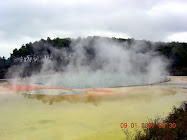
Champagne Pool
Colouful mineral deposits in overflow from Champagne Pool Hot Spring
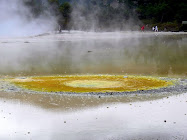
Devil's Ink Pots
Devil's Ink Pots (crude oil and graphite form dark areas on surface.
Thunder Crater
Thunder crater - collapse feature formed in 1968.
Keep Off The Grass!
We were told not to try dipping our hand in any of the pools or go walking off the designated tracks - otherwise we'd "fry."
Primrose Sinter Terrace
After destruction of the Pink and White terraces in lake Rotomahana by the 1886 eruption of Mt. Tarawera, touristic focus in the area shifted to Wai-O-Tapu which had the largest remaining sinter terrace in New Zealand.
Wai-O-Tapu is located on the northern perimeter of the Reporoa caldera. This caldera is approximately 10x15 km in size and was formed 230000 years ago during a massive eruption which emplaced 100 cubic kilometers of breccia (ash and pumice) referred to as the Kaingaroa Ignimbrites. These are over 30m thick in places. Around the time of the Kaharoa eruption of nearby Tarawera (800 years ago) a number of large hydrothermal eruptions occurred in Wai-O-Tapu. Drill holes at Wai-O-Tapu show that the current source of heat is located under the N margin of Reporoa and the S part of Wai-O-Tapu.
Rainbow Crater
Colours are the result of sulphur and other minerals exposed.
Obey The Signs
Tēnā koutou katoa
This is all about New Zealand - Aotearoa - and the time I spent there. Magical times, beautiful scenery, gushing geysers, thermal wonderlands. Hear about Waitangi Day, discover the meaning of the word "Aotearoa", see the Glaciers, read about hangis and Hakas, and visit the beautiful Bay of Islands. So come with me on a journey - a journey to The Land of The Long White Cloud.
Kia ora
CHRISTCHURCH EARTHQUAKE TRIBUTE 2011
Kia ora
Watch The Haka
Showing posts with label z Wai-O-Tapu. Show all posts
29. Rotorua - Wai-O-Tapu
Tuesday 9 January
Artist's Palette
Sulphur rich hot spring. Overflowing water from the Champagne Pool draws with it minerals that have originated from below the surface. As the waters cool and the minerals are exposed to the atmosphere, they show in a variety of colours depending on wind direction and water level.
Thou Shalt Not Throw Stones!
The sign speaks for itself.
Opal Pool
Such a beautiful colour, but oh, so deadly.
Sinter (Silica)Terrace Crossing
Champagne Pool
The surface features of the geothermal area are generated by groundwater that is superheated deep underground by old magma bodies which have not yet fully cooled. The superheated water dissolves minerals from rocks and deposits underground and deposits these in places where it reaches the surface and evaporates.
The colours of the deposits indicates the minerals involved in the process - green (colloidal sulphur / ferrous salts), orange (antimony), purple (manganese oxide), white (solica), yellow (sulphur), red (iron oxides) and black (sulphur / carbon).
Artist's Palette
Sulphur rich hot spring. Overflowing water from the Champagne Pool draws with it minerals that have originated from below the surface. As the waters cool and the minerals are exposed to the atmosphere, they show in a variety of colours depending on wind direction and water level.
Thou Shalt Not Throw Stones!
The sign speaks for itself.
Opal Pool
Such a beautiful colour, but oh, so deadly.
Sinter (Silica)Terrace Crossing
Champagne Pool
The surface features of the geothermal area are generated by groundwater that is superheated deep underground by old magma bodies which have not yet fully cooled. The superheated water dissolves minerals from rocks and deposits underground and deposits these in places where it reaches the surface and evaporates.
The colours of the deposits indicates the minerals involved in the process - green (colloidal sulphur / ferrous salts), orange (antimony), purple (manganese oxide), white (solica), yellow (sulphur), red (iron oxides) and black (sulphur / carbon).
28. Rotorua - Wai-O-Tapu
Tuesday 9 January
Rainbow Crater
Well over a dozen craters are located within close proximity. They range from 5-50 metres in diameter and up to 20 metres deep. All were formed by the ground surface collapsing. It is believed under this area subterranean waterways have eroded away rock structure alowing the surface ground to collapse away forming craters. Many craters have various types of geothermal activity such as boiling pools, steam fumeroles, sulphur vents and mud pools. The pumice ground is this area is coloured by various oxides.
Purple - Magnanese Oxide,
Red/Brown - Ferrous Oxide
Yellow - Sulphur.
Inferno Crater
The crater has a bottom of violently boiling mud. In recent history an earth archway linking the sides has been completely destroyed by the action of acidic steam.
Champagne Pool
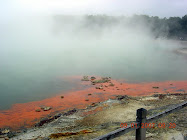
The pool fills a 900 year old crater which is roughly 60 metres across and 60 metres deep. The waters are tinted green with arsenic, sulphur and iron compounds. It bubbles with carbon dioxide at about 74º C and deposits orange antimony and traces of gold, silver and mercury on its rim and the huge sinter terraces that drain it.
Champagne Pool
Orange Antimony-rich deposits. The Champagne Pool is the most colourful and most popular.
Champagne Pool
Mineral deposits give the Champagne Pool at Wai-O-tapu Thermal Wonderland near Rotorua its edges the beautiful colours and unique formations
Rainbow Crater
Well over a dozen craters are located within close proximity. They range from 5-50 metres in diameter and up to 20 metres deep. All were formed by the ground surface collapsing. It is believed under this area subterranean waterways have eroded away rock structure alowing the surface ground to collapse away forming craters. Many craters have various types of geothermal activity such as boiling pools, steam fumeroles, sulphur vents and mud pools. The pumice ground is this area is coloured by various oxides.
Purple - Magnanese Oxide,
Red/Brown - Ferrous Oxide
Yellow - Sulphur.
Inferno Crater
The crater has a bottom of violently boiling mud. In recent history an earth archway linking the sides has been completely destroyed by the action of acidic steam.
Champagne Pool
The pool fills a 900 year old crater which is roughly 60 metres across and 60 metres deep. The waters are tinted green with arsenic, sulphur and iron compounds. It bubbles with carbon dioxide at about 74º C and deposits orange antimony and traces of gold, silver and mercury on its rim and the huge sinter terraces that drain it.
Champagne Pool
Orange Antimony-rich deposits. The Champagne Pool is the most colourful and most popular.
Champagne Pool
Mineral deposits give the Champagne Pool at Wai-O-tapu Thermal Wonderland near Rotorua its edges the beautiful colours and unique formations
27. Rotorua - Geysers & Geothermal Wonders
Tuesday 9 January
Our driver, Paris was over 25 minutes late in arriving and told us he didn't have time because of this to take us past the Government Gardens. Many, in fact, most, of the passengers complained loudly about this, as this was one of our "highlights", and you could have cut the air with a knife - the temperature dropped about 10 degrees! He (the driver) tried very hard to joke and stuff, but the passengers were not forgiving.
Wai-O-Tapu was fantastic, but we didn't have nearly enough time there. The time spent at a bungy jumping place later in the day was very long and very boring. It would have been better having more time at the geothermal areas and less at the bungy jump. We had to drive past the hostels to get to the bungy thing and many passengers asked could they be dropped off there as they weren't interested in looking at the bungy jump place.
Nothing doing - we all had to hang around at the bungy jump place. The weather had steadily worsened after leaving Wai-O-Tapu, and it was absolutely pouring, and when we did finally get to our hostels, you couldn't go anywhere - it just continued to pour buckets.
Geothermal Activity
As we approached the geothermal areas you could see the activity going on from the bus.
Lady Knox Geyser
Our first stop was at the Lady Knox Geyser which erupts every day at 10.15am - soap is dropped into the opening vent to ensure this occurs. Depending on the weather, the eruption can be up to 20m and rocks are placed around the base to enhance this.
Lady Knox Geyser
In 1901 the first open prison in New Zealand was established at Wai-O-Tapu to house some of the better behaved prisoners from around the gaols of the Rotorua Lakes District.
Some of those prisoners discovered the clearing in which the geyser is situated and that the spring could be made to erupt by adding soap - as they found when they first used the hot water to wash their clothes.
Our next stop was at Wai-O-Tapu which in English means "Sacred Waters."
Wai-O-Tapu
Above is the entrance which leads to a gift shop with many souvenirs for sale.
Entrance Garden
After going through the gift shop, you walk along this walkway which leads you to the geothermal "park."
Map of Wai-O-Tapu
Steaming Fumeroles - The Devil's Home
The Devil's Bath Lake
The green color is from colloidal sulphur/ferrous salts.
The luminous green Devil's Bath is a large rugged edged crater near the bush line with amazing natural water colour at its base. The colour comes from the excess water from the champagne pool mixing with sulphur and ferrous salts. Changes in colour through Green to Yellow are associated with the amount of reflecter light and cloud cover.
Our driver, Paris was over 25 minutes late in arriving and told us he didn't have time because of this to take us past the Government Gardens. Many, in fact, most, of the passengers complained loudly about this, as this was one of our "highlights", and you could have cut the air with a knife - the temperature dropped about 10 degrees! He (the driver) tried very hard to joke and stuff, but the passengers were not forgiving.
Wai-O-Tapu was fantastic, but we didn't have nearly enough time there. The time spent at a bungy jumping place later in the day was very long and very boring. It would have been better having more time at the geothermal areas and less at the bungy jump. We had to drive past the hostels to get to the bungy thing and many passengers asked could they be dropped off there as they weren't interested in looking at the bungy jump place.
Nothing doing - we all had to hang around at the bungy jump place. The weather had steadily worsened after leaving Wai-O-Tapu, and it was absolutely pouring, and when we did finally get to our hostels, you couldn't go anywhere - it just continued to pour buckets.
Geothermal Activity
As we approached the geothermal areas you could see the activity going on from the bus.
Lady Knox Geyser
Our first stop was at the Lady Knox Geyser which erupts every day at 10.15am - soap is dropped into the opening vent to ensure this occurs. Depending on the weather, the eruption can be up to 20m and rocks are placed around the base to enhance this.
Lady Knox Geyser
In 1901 the first open prison in New Zealand was established at Wai-O-Tapu to house some of the better behaved prisoners from around the gaols of the Rotorua Lakes District.
Some of those prisoners discovered the clearing in which the geyser is situated and that the spring could be made to erupt by adding soap - as they found when they first used the hot water to wash their clothes.
Our next stop was at Wai-O-Tapu which in English means "Sacred Waters."
Wai-O-Tapu
Above is the entrance which leads to a gift shop with many souvenirs for sale.
Entrance Garden
After going through the gift shop, you walk along this walkway which leads you to the geothermal "park."
Map of Wai-O-Tapu
Steaming Fumeroles - The Devil's Home
The Devil's Bath Lake
The green color is from colloidal sulphur/ferrous salts.
The luminous green Devil's Bath is a large rugged edged crater near the bush line with amazing natural water colour at its base. The colour comes from the excess water from the champagne pool mixing with sulphur and ferrous salts. Changes in colour through Green to Yellow are associated with the amount of reflecter light and cloud cover.
Subscribe to:
Posts (Atom)